
It’s a Tuesday morning at a busy workshop in Brookvale. A SafeWork NSW inspector walks in, picks up an extension lead from the floor and asks one simple question: “When was this last tested?”
If nobody knows, the owner has a problem. And it’s a common one. Plenty of Sydney businesses test their gear once, stick a tag on it and then forget about it for years.
So how often is often enough? The honest answer is that NSW law doesn’t give one date for every business. It depends on where the equipment is used. Here’s how it works, so you can set a schedule that actually fits your workplace.
What does NSW law actually say about test and tag?
Here’s something many owners don’t realise. The law doesn’t use the words “test and tag”. What it requires is regular inspection and testing of plug-in electrical equipment by a competent person.
SafeWork NSW says a business must make sure equipment is regularly inspected and tested if it plugs into a socket outlet and is used where normal use is likely to damage it or shorten its life. That means conditions like moisture, heat, vibration, mechanical damage, corrosive chemicals or dust.
The tag is just one way to keep the record. The standard that explains how to do the testing is AS/NZS 3760, which covers inspection, testing and tagging methods. Construction and demolition sites follow a separate standard, AS/NZS 3012.
SafeWork’s code of practice also says the frequency depends on the workplace, its environment and the risks. So it’s your job to work out which category you fall into, and to be able to show why.
How often does commercial test and tag have to be done in NSW?
For commercial test and tag in NSW, think in steps. The riskier the environment, the more often you test. Here’s the guide from the SafeWork NSW code, plus the usual practice for lower-risk places:
| Environment | Typical interval | Where it comes from |
| Construction and demolition sites | Every 3 months | AS/NZS 3012, as applied by SafeWork NSW |
| Hire equipment | Inspect at the start of each hire, test every 3 months | SafeWork NSW code |
| Workshops, manufacturing and commercial cleaning equipment | At least every 6 months | SafeWork NSW code |
| Other higher-risk areas, such as commercial kitchens, wet or dusty areas and outdoor equipment | At least every 12 months | SafeWork NSW code |
| Offices, retail shops and classrooms | Less often, based on a risk assessment | SafeWork NSW code and AS/NZS 3760 |
For the lower-risk row, testing providers who summarise the standard say stationary office equipment can sit on long intervals, up to five years in some cases. That’s only sensible when the gear is never moved or damaged, and you’ve written down why. Please treat it as a ceiling, not a default.
One more note. The SafeWork code still refers to the 2010 version of AS/NZS 3760 in places, but the current edition is 2022. A good tester works from the 2022 version, so it’s worth asking which one they use.
What counts as a harsh environment?

This is the part that trips people up. SafeWork’s code gives examples of higher-risk environments: wet or dusty areas, outdoors, places that use corrosive substances, commercial kitchens and manufacturing.
In Sydney, that covers a lot of ground. A café or restaurant kitchen is a harsh place for electrical gear, with steam, grease and constant knocks. A trade workshop in Brookvale or Mona Vale has dust, vibration and leads dragged across the floor. A warehouse, a car wash, a salon with wet floors or an outdoor dining area all count too. Near the coast, salt air can speed up corrosion on outdoor equipment.
A quiet office is different. If the equipment sits on a desk, never moves and stays clean and dry, that’s lower risk. But “office” isn’t a free pass. A back room full of extension leads and heaters isn’t an office environment, even if it sits inside one.
If you’re not sure, do a simple risk assessment. Walk through each area and ask whether the equipment gets wet, hot, dusty, bumped or moved. Write down your answers.
What equipment needs testing and tagging?
Anything that plugs into a socket outlet and is exposed to wear. That includes power tools, extension leads, power boards, portable heaters, fans, kettles, microwaves, toasters, vacuum cleaners and portable RCDs. In offices, it also covers items like monitors, printers and chargers, on a lower-risk schedule.
New and second-hand gear has its own rules. According to the SafeWork code, brand new equipment doesn’t need testing before first use, but it should be visually checked for damage and recorded so it doesn’t miss its first scheduled test. Second-hand equipment should be tested before its first use. Anything repaired or serviced in a way that could affect electrical safety should be tested before it goes back into service.
What about safety switches (RCDs)?
Safety switches are covered by their own rule. Under the WHS Regulation, the person managing a workplace must take reasonable steps to make sure RCDs are tested regularly by a competent person, and that covers fixed ones at the switchboard too.
If one fails, it has to be taken out of service and replaced as soon as possible. You also need to keep a record of the test until the next one.
There are two kinds of test. The push-button test just proves the mechanism trips. The timed trip test uses an instrument to measure how fast it cuts the power. Testing providers commonly run the timed test around every 12 months, and up to every 24 months in low-risk offices, but the exact intervals depend on the device and setting. Ask your tester to show you which table they’re working from.
Who is allowed to test and tag?
SafeWork NSW says testing must be done by a competent person. That includes a licensed or registered electrician, and in some cases a person who’s completed structured training in using a pass or fail tester and inspecting equipment visually.
There’s a limit, though. Some kinds of testing, such as anything that involves taking equipment apart, must be done by a licensed electrician. RCD trip-time testing and anything involving fixed wiring or switchboards also sits better with a licensed professional. If you’re unsure, a commercial electrician Sydney can tell you which jobs a basic tester can handle and which need a licence.
What records do you need to keep?
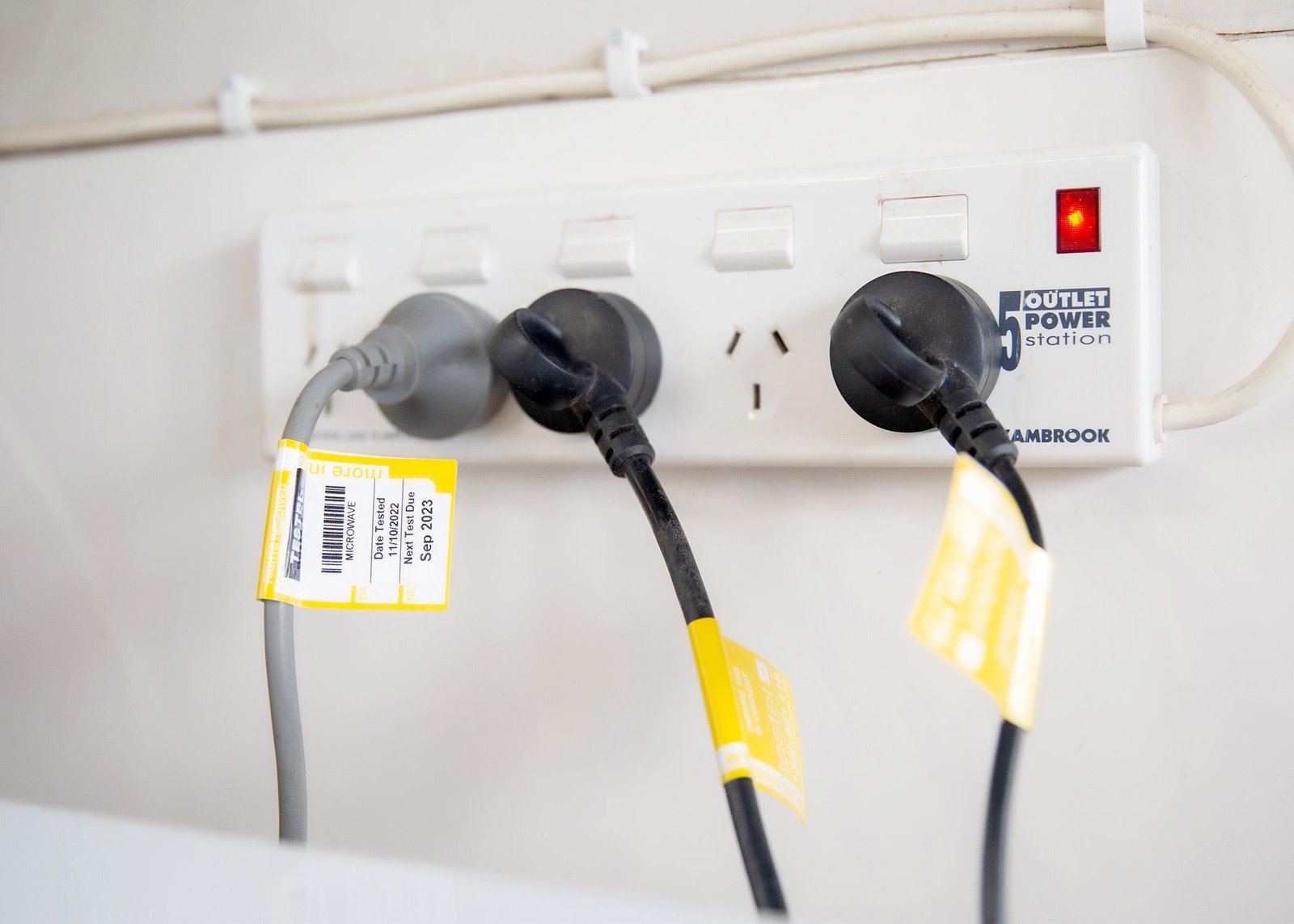
NSW law is clear on this. You must keep a record of testing until the equipment is next tested, permanently removed from the workplace or disposed of. Each record has to show four things: the name of the person who did the testing, the date, the outcome, and the date the next test is due.
A tag can do the job, but a tag may not hold all four details. That’s why many businesses also keep a logbook or asset register, which gives you a backup if a tag falls off or gets damaged. It also makes audits a lot easier.
For the tag itself, the code suggests it should be durable, water-resistant, non-metallic, secure and impossible to reuse. Some businesses colour-code tags by month so overdue items stand out at a glance.
What happens if something fails the test?
Pull it from use straight away. Under the WHS Regulation, unsafe electrical equipment has to be disconnected or isolated and not reconnected until it’s been repaired and tested by a competent person, replaced or permanently removed.
Label it as unsafe, so nobody grabs it by mistake. Many workplaces use “out of service” tags for this, and store failed items in a locked area until they’re dealt with.
How do you set up a simple testing schedule?
You don’t need anything fancy. Most businesses can sort it out in an afternoon:
- List every plug-in item and where it lives.
- Group each area by risk: construction, workshop, kitchen or wet area, outdoor, or office.
- Set an interval for each group using the table above.
- Book a competent tester and put the next dates in your calendar.
- Keep your records in one place, with the tag details backed up in a register.
- Review it each year, and again if your equipment or workspace changes.
A typical café might test kitchen gear every 12 months and office gear less often. A workshop might test everything every 6 months. A hire business would test every 3 months and inspect before each hire. If you’re unsure, shorter is safer.
What are the most common mistakes?
A few come up again and again. Businesses test once and then forget. They treat a whole site as an office when half of it is a workshop. They rely on tags but keep no records. They skip RCDs, or they have a staff member without training use a tester they don’t understand. And they forget about the extension leads, which take the most punishment of anything on site.
Each of those can leave a gap that a SafeWork inspector, or an insurer after an incident, will pick up on.
The bottom line
There’s no single date that fits every business. In NSW, you test regularly, at a frequency that matches your risks, using a competent person, and you keep records. As a guide, that means every 3 months on construction sites and for hire gear, at least every 6 months in workshops, at least every 12 months in other tougher environments and on a risk-based schedule for offices and shops. RCDs have their own testing on top.
If you manage a commercial site on the North Shore, Northern Beaches, Inner Sydney or the Eastern Suburbs and aren’t sure where you stand, ACE Catlin Electrical can help. As a commercial electrician in Sydney, we can check your switchboard and safety switches, tell you what your site needs and help you set up a testing schedule that stands up to an inspection.
Frequently Asked Questions
Is test and tag compulsory in NSW?
The law requires regular inspection and testing of plug-in equipment in higher-risk environments, by a competent person, with records. A tag is the most common way to show the record, but it isn’t the only way.
Do offices need test and tag?
Usually less often, but they’re not automatically exempt. The SafeWork code says lower-risk workplaces such as offices, retail shops and classrooms may still need testing on a less frequent basis. A short written risk assessment backs up your interval.
Does new equipment need to be tested before use?
Not if it’s brand new, but it should be visually inspected for damage and recorded so it’s included in your schedule. Second-hand equipment should be tested before it’s first used.
How long does a test and tag last?
Until the due date on the tag or in your register. That date depends on your environment, so it could be 3, 6 or 12 months, or longer for low-risk office equipment.
Can my staff do the testing?
A person who’s completed structured training in using a pass or fail tester can do basic appliance testing in some cases. Anything involving taking equipment apart, fixed wiring or RCD trip-time testing should go to a licensed electrician.


